Chinchintei
珍々亭
Bucket List — Worth the effort
This shop is not easy to visit as a tourist — expect long waits, limited English, and a traditional ordering process. But that's the point. This is the real thing, and the experience is part of the story.
Traveler tip: No cards or IC accepted — cash only, and the menu is Japanese. Just say 'abura-soba nami' (regular) to order, and arrive at 11 AM opening or after 2 PM to skip the peak queue.
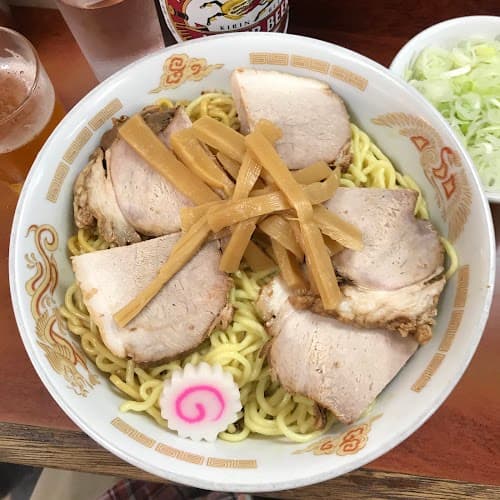
Signature bowl
Recognition
For travelers
Based on public sources and AI research. Not personally verified — confirm before visiting.
Why this shop
Abura-soba — the soup-less noodle bowl now found in shops across Tokyo — is widely traced back to this counter in Musashisakai. Chinchintei opened in 1957, during the postwar years when students at the nearby Musashino-area universities needed something cheap, filling, and fast. The answer, drawn from Chinese mixed noodles (拌麺, banmen), was thick noodles tossed at the bottom of the bowl with a dark soy tare and aromatic oil. The category that grew out of that bowl — abura-soba — is now one of Tokyo's most distinct ramen traditions, and Chinchintei is the shop most writers, including Time Out Tokyo, name as its originator.
What you get here is not a nostalgia act. It's a functioning daytime ramen shop that runs the same simple bowl it has run for nearly seventy years, with the same minimal toppings — chashu, menma, scallion — and the same stirring ritual. The interior is small, worn, and entirely focused on turning bowls fast. Most visitors who come for the history leave impressed that the food itself holds up against the modern specialist shops that have built whole menus on Chinchintei's template.
What to order
Order the 油そば 並 (abura-soba, regular, ¥950). The larger size 大 (¥1,050) is for serious eaters — the regular is the right size to experience the bowl as designed.
When it arrives, you'll see thick, glossy noodles with a few slices of chashu, menma, and scallion on top. Underneath is a pool of dark soy tare and aromatic oil — this is the sauce, and it needs work to do its job. Take your chopsticks, go to the bottom of the bowl, and lift the noodles up through the tare for a full 20 to 30 seconds until every strand is coated and glossy. Then taste. Add a splash of vinegar from the table (brightens the whole bowl) and a drop of chili oil (adds heat) to dial it in.
If you're still hungry at the end, ask for oi-meshi (追い飯) — a small scoop of rice dropped into the residual tare at the bottom of the bowl, mixed, and eaten as the final bite. It's the abura-soba equivalent of soup wari, and it's how regulars finish the meal.
Practical notes
Chinchintei is a 12-minute walk from Musashisakai Station on the JR Chuo Line — from central Tokyo (Shinjuku), that's about 20 minutes on the rapid service. Walk out of the station, follow the main shopping street south, and look for the small white sign on a quiet side street.
The shop is open from 11:00 to 16:00, Monday through Saturday, and closed on Sundays and public holidays. There is no ticket machine — when you get a seat, a staff member will take your order verbally and you pay in cash at the end. Neither credit cards nor IC cards (Suica / Pasmo) are accepted, and the menu is in Japanese only. Seating is about 22 — a short counter of six plus four small tables — all turned over quickly.
How to visit
Chinchintei sits outside the usual tourist ramen circuit — there is no English signage, no translated menu, no online booking, and no way to pay except cash. Treat it as a dedicated trip rather than a casual drop-in. Arrive right at the 11:00 opening or after 14:00 to avoid the lunch peak; the in-between hours can pack out the counter within minutes. Bring cash for the bowl (plan for ¥1,000–1,100) and know the word "abura-soba" (油そば) and the size you want ("nami" 並 for regular, "ōmori" 大 for large) — that is enough to order without any other Japanese.
Practical info
| Address | 5-17-21 Sakai, Musashino-shi, Tokyo 180-0022 |
| Nearest station | Musashisakai Station (JR Chuo Line) |
| Walk time | 12 min |
| Hours | Mon-Sat 11:00-16:00 (until sold out); closed Sun & public holidays |
| Wait — weekday lunch | 15-30 min at peak (12:00-13:00); 5-15 min off-peak |
| Wait — weekday dinner | |
| Wait — weekend | Closed Sun/holidays; Saturday similar to weekday peak |
| Reservation | Walk-in only |
| Map | Open in Google Maps |
Last verified on April 20, 2026. Prices and hours may change — always check official sources before visiting.