Chuka Soba Aoba Nakano Honten
中華そば 青葉 中野本店
Traveler tip: Order the 中華そば (Chuka Soba, ¥750) for the double-soup shoyu that put the shop on the map. Cash only — no card, no IC, no QR. Peak lunch waits are 20–40 min but quiet windows before 11:30 or after 14:00 are often walk-in under 10 min.
Signature bowl
Recognition
For travelers
Based on public sources and AI research. Not personally verified — confirm before visiting.
Why this shop
Aoba is widely credited with popularizing the double-soup (ダブルスープ) — the technique of blending two separately prepared broths in a single bowl, one animal-based and one seafood-based. The shop opened in Nakano in the mid-1990s, mixing a chicken-and-pork broth with a Tokyo-style fish stock, and the result is widely considered one of the most influential shoyu ramen innovations of the 1990s — a technique that spread across Tokyo and can be tasted in dozens of modern seafood-shoyu shops today. Tabelog sits at 3.54 with over 1,700 reviews, and Time Out Tokyo still lists the Nakano Honten as a must-eat in the neighborhood.
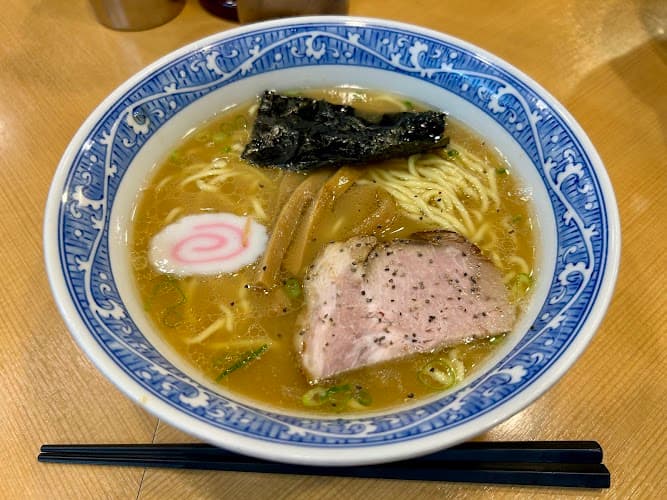
The bowl itself is deliberately restrained. The base is a classical Tokyo shoyu — clear, amber, soy-tare-forward — but underneath runs the distinctive seafood layer: dried bonito, dried sardine, kombu, mixed with a chicken-and-pork collagen broth. On the tongue it reads as shoyu with a marine depth that shoyu alone does not have. The noodles are medium-thickness, made to hold both sides of the double soup without disappearing into either. Toppings are the classical Tokyo set: two slices of chashu, menma, a nori sheet, chopped scallion.
Aoba is a historical shop. Prices are low by 2026 Tokyo standards — the signature bowl is under ¥800 — and the service is quick and unfussy. The value is not in atmosphere; it is in eating the bowl that changed Tokyo ramen, at the shop where it was invented.
What to order
Order the 中華そば (Chuka Soba, ¥750). This is the original double-soup bowl and the reason to come. The menu also offers a つけ麺 (tsukemen, ¥800) for those who prefer a dipping version, and a 特製中華そば (tokusei, ¥930) with an extra slice of chashu and a seasoned egg. On a first visit, stay with the standard Chuka Soba — it is the bowl that built the shop's reputation.
When you sit down, the staff will serve the bowl quickly. This is not a shop that lingers over plating or presentation; the turn rate is high and the pace matches. Eat while it is hot, drink some of the broth before the noodles swell, and you will understand why this style spread. There is no soup-wari tradition here — this is a ramen shop, not a tsukemen shop, even with the double-soup innovation.
Practical notes
Aoba is a 5-minute walk from the North Exit of Nakano Station (JR Chuo Line / Tokyo Metro Tozai Line). Leave via the North Exit, cross into the Nakano Sun Mall arcade, walk straight through to the back end, and the shop is in a small building on the right shortly after. The storefront is modest — look for the small sign reading 青葉.
The shop runs daily 10:30–21:00 with no mid-afternoon break. Seating is 13 counter seats only, with a ticket machine inside the entrance. The ticket machine has photo-labeled buttons for the main bowls which makes ordering possible without Japanese, though the English menu itself is limited. Payment is cash only — no card, no IC, no QR. Bring ¥1,000–1,500 in cash per person.
Wait times are the most traveler-friendly feature of this shop. At lunch peak (12:00–13:00) you might wait 20–40 minutes, but arrive before 11:30 or after 14:00 and walk-in times often drop under 10 minutes. Weekday dinner is usually 10–20 minutes. For a shop with Aoba's historical weight, this is as accessible as a Tokyo tonkotsu-era-defining bowl gets.
Why this location
Aoba runs roughly 19 locations across Tokyo and surrounding prefectures — 18 branches plus the Nakano Honten (Iidabashi, Hachioji, Fuchu, Ikebukuro Sunshine, Okachimachi, Kinshicho, Higashikurume, Higashiyamato, Kichijoji, and more in Tokyo; plus Omiya and Sayama in Saitama, Funabashi in Chiba, Kawasaki Azalea in Kanagawa, and Tsukuba in Ibaraki). All follow the same recipe.
We direct travelers to the Nakano Honten (中野本店) because this is where the double-soup was invented in 1996, where the method was refined, and where the shop's reputation was built. The other branches are competent but the honten is the reference. Nakano itself is an easy visit: 5 minutes on the JR Chuo Line from Shinjuku, with a vibrant shotengai (Nakano Sun Mall) leading directly to the shop from the station.
Related guides
Practical info
| Address | 1F Nakano Maruhiru, 5-58-1 Nakano, Nakano-ku, Tokyo |
| Nearest station | Nakano Station (JR Chuo Line / Tokyo Metro Tozai Line) North Exit |
| Walk time | 5 min |
| Hours | Daily 10:30–21:00 |
| Wait — weekday lunch | 20–40 min at peak (12:00–13:00); under 10 min before 11:30 or after 14:00 |
| Wait — weekday dinner | 10–20 min typical |
| Wait — weekend | 30–60 min at peak lunch |
| Reservation | Walk-in only |
| Map | Open in Google Maps |
Last verified on April 19, 2026. Prices and hours may change — always check official sources before visiting.