Kanda Ramen Waizu (Kanda Main)
神田ラーメン わいず 神田本店
Traveler tip: Cash payment only and Japanese-only ticket machine — buy before sitting. Lunch queue averages 30 minutes; afternoon lull (14:00–15:00) and late night after 22:00 are quietest.
Signature bowl
Recognition
For travelers
Based on public sources and AI research. Not personally verified — confirm before visiting.
Why this shop
Kanda Ramen Waizu has been Kanda's most reliably packed ramen counter for over two decades. Founded in 2000, it established itself during the early wave of "iekei-inspire" shops — shops that adopted the thick, pork-bone-and-soy-sauce style pioneered by Yokohama's Yoshimuraya in 1974 without belonging to its direct apprenticeship line. Unlike "chokkei" (直系) iekei shops that end in "-ya" (家), Waizu charted its own identity in central Tokyo.
The recognition speaks for itself. Waizu won TRY Ramen Awards' Newcomer Prize in 2015–16, appeared in Time Out Tokyo's ramen coverage, and claimed SILVER at the 2025 Takumen Ramen Awards — a rare triple across different criteria. On Tabelog, it sits at 3.74 with over 3,300 reviews, putting it in the "very good" tier that reliably signals a shop worth crossing neighborhoods for.
What distinguishes Waizu in Tokyo's crowded iekei scene is the balance of its broth. Many iekei shops push toward extreme thickness or aggressive salt; Waizu's pork-bone-shoyu broth is dense but drinkable, with a more assertive chicken-oil layer than the average. The noodles — thick, straight, short-cut, almost udon-like — hold up to that weight without becoming gummy. It's the kind of iekei that converts skeptics: rich enough to feel indulgent, balanced enough to finish the bowl.
Waizu has grown beyond its Kanda roots, with an Akihabara branch and a sister brand called Chuka-soba Kitomi. But the Kanda main shop remains the one to visit — this is where the recipe was developed, and where the weekday-late-night crowd forms the queue that's defined this corner of Uchi-Kanda for 25 years.
What to order
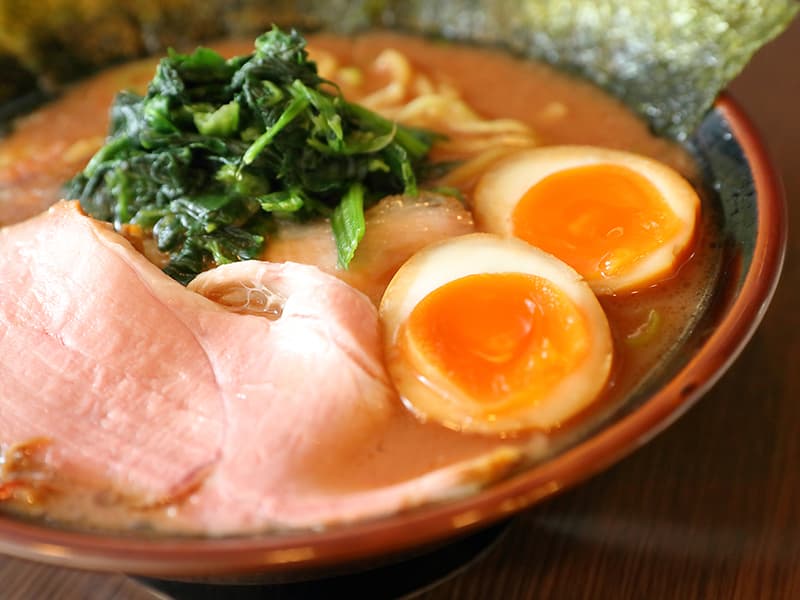
The signature order is straightforward: Ramen (¥980), a bowl of thick tonkotsu-shoyu broth topped with the classic iekei trio of spinach, sheets of nori, and chashu. This is the baseline — order this on your first visit before exploring any variations.
If this is your first iekei experience, stick with the standard "three futsuu" customization: futsuu (normal) noodle firmness, futsuu (normal) oil, futsuu (normal) saltiness. Only adjust after you know how the default tastes. The counter staff will ask these three questions when you hand over your ticket — all you need is "futsuu, futsuu, futsuu."
Add a small bowl of rice (around ¥100). The locals' technique: dip one of the nori sheets into the broth until it softens, wrap it around a chunk of rice, and eat it alongside the noodles. Iekei is designed to be eaten with rice in a way no other ramen style is. Skip this and you're missing half the experience.
For upgrades, extra chashu, a boiled egg (ajitama), or a noodle refill (kaedama) are common add-ons at the ticket machine.
Practical notes
Kanda Ramen Waizu occupies the first floor of the Okuma Building, two minutes from the west exit of Kanda Station (served by JR Yamanote, JR Keihin-Tohoku, JR Chuo, and the Ginza Line). Walk west from the station's west exit; the entrance is visible from street level with the clear Waizu signage.
Order before sitting: buy your ticket at the vending machine just inside the entrance. The ticket machine is button-based with limited visual references — most options are in Japanese only. "Ramen" (ラーメン) is the top option. Hand the ticket to the counter staff when you sit down, then answer the three customization questions (noodle / oil / saltiness; say "futsuu, futsuu, futsuu" to start).
Payment is cash only — no credit cards, no IC cards (Suica/Pasmo), no QR codes accepted. Bring yen.
Seating is 11 counter seats, smoke-free. Expect a 30-minute queue during weekday lunch — the line moves fast, but peak hours (12:00–13:30 lunch, 19:00–20:00 dinner) can stretch to 40–60 minutes. For the shortest wait, aim for the 14:00–15:00 afternoon lull or late night after 22:00; the shop stays open until 24:00 Monday through Thursday and until 1 AM on Friday nights.
Closed Sundays. Saturday and holiday hours close early at 21:00, with lunch-oriented crowds.
Why this location
While Waizu has an Akihabara branch and a sister brand (Chuka-soba Kitomi), the Kanda main shop is where the recipe and technique were refined starting in 2000. The other locations are standardized operations; the Kanda shop is the one with the 25-year history, the regular-customer culture, and the staff who worked directly with the founders. For travelers making a single visit, this is the one.
Related guides
Practical info
| Address | 1F Okuma Bldg, 3-9-6 Uchi-Kanda, Chiyoda-ku, Tokyo |
| Nearest station | Kanda Station (JR Yamanote / Keihin-Tohoku / Chuo / Ginza Line) |
| Walk time | 2 min |
| Hours | Mon–Thu 10:30–24:00 / Fri 10:30–25:00 / Sat & Holidays 10:30–21:00 / Closed Sun |
| Wait — weekday lunch | 30 min typical (up to 40–60 min at 12:00–13:30 peak) |
| Wait — weekday dinner | 30–40 min typical (up to 60 min at 19:00–20:00 peak) |
| Wait — weekend | Saturday and holiday lunch concentrated; 30–60 min typical |
| Reservation | Walk-in only |
| Map | Open in Google Maps |
Last verified on April 18, 2026. Prices and hours may change — always check official sources before visiting.